Conserving the Wildlife Treasures of the Pembrokeshire Coast
19 February 2008
Sea
Trust South and West Wales monitors the seas, educating people about
the glories of Welsh marine wildlife. These include; "Porpoise Picnics"
and outreach such as an exhibition which opened at the National Museum
of Wales in Cardiff and then toured the UK.
|
"Marine
megafauna such as whales and dolphins, are difficult to get a handle
on. Not enough is known about them. Sea Trust is about local people
taking responsibility for monitoring and conserving their own
wildlife," says Cliff Benson, Director of the Pembrokeshire-based
organisation, which is the marine arm of the Wildlife Trust South and
West Wales. As an volunteer community group charity, they have many
projects conserving, monitoring and recording the sea creatures around
the coast of South West Wales.
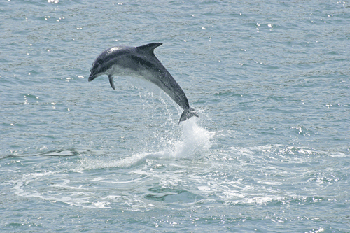
They investigate Common, Bottlenose,
and Risso's Dolphins, as well as Harbour Porpoises. Other marine life
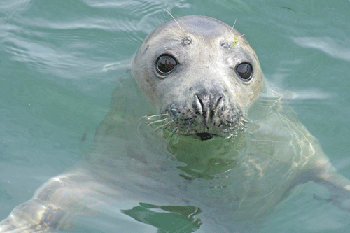
such as whales, seals, sharks, various fish, turtles and plankton are
also surveyed by Sea Trust volunteers in Pembrokeshire - the only
coastal National Park in the UK, which has one of the only three Marine
Nature Reserves and two Special Areas of Conservation (SACs) designated
under the EU Habitats and Species Directive. This makes it one of
Britain's wildlife treasure troves.
|
The
oceans are already showing the effect of the carbon that is dumped in
it from the atmosphere. Mark Lynas, in his book Six Degrees, about
global warming, says that humans have already managed to reduce the
alkalinity of the seas by 0.1 pH units. This means the sea is becoming
more acidic, which will have effects on everything that dwells there.
Monitoring what is happening around our coasts is vital to obtain
information about the impact of climate change on fish, algae,
plankton, and of course sea mammals such as whales and dolphins - who
are particularly vulnerable as they are at the summit of the food
chain. This is on top of the disruption caused to them from oil spills
and jet-skis.
These strongholds of marine wildlife are also
being probed by energy companies in the search for good areas for
renewable energy - rugged places with high wind speeds or big tidal
ranges are prime sites for wind, wave or tidal stream projects. While
being pragmatic, Cliff Benson is concerned that with commercial
interests, conservation becomes secondary. He says that by working with
conservationists from the beginning the needs of commerce and
conservation can be balanced: "In my view it is win/win."
One of
the greatest concerns for Seatrust volunteers is that although
theoretically the areas are legally protected, in reality, there is
little enforcement. Cliff Benson would like to see marine rangers who
could prevent people doing harmful things to the environment. He is
also concerned that - unlike driving a car - there is no need for a
licence for powered craft . A proper nationwide licencing system for
them would massively contribute to safety whilst paying for adequate
policing.
|
To
promote responsible, sustainable tourism, Sea Trust, Stena Lines and
Pembrokeshire County Council are promoting West Wales as "The Dolphin
Coast", with the intention of showing off the wildlife as a natural
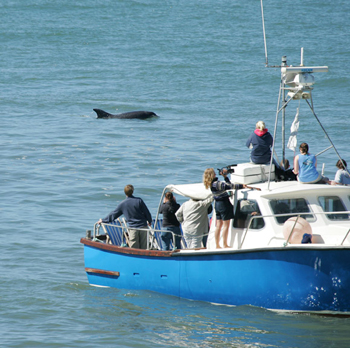
asset that should be valued and conserved. There are whale-watching
cruises and nature photography courses available for the eco tourist at
www.dolphincoast.co.uk .
Links:
Seatrust: www.seatrust.org.uk
Dolphin Coast www.dolphincoast.co.uk
Pembrokeshire National Park www.pcnpa.org.uk
Naturewatching Cruises: www.ramseyisland.co.uk
Images courtesy of Janet Baxter: www.cymriccards.co.uk
|