The Tide is Nigh
18 February 2008
|
| Photo credit Pelamis Wave Power |
Britain
is blessed with an abundance of potential renewable sources of
energy. Besides wind, there is also wave and tidal stream
power. This is an industry in its infancy, despite being a source
of electricity going back to the 1970s, because finance and innovation
have not been forthcoming. If the German wind industry is a guide
– the UK is in a position to create jobs and profits by being at the
cutting edge of a new technology. In Germany a quarter of a
million jobs have been created through the design, manufacture and
maintenance of wind turbines.
According to CAT
Development Director Paul Allen, Britain has enormous potential for
marine renewable energy generation. Tim Ovens, project director of The
Renewable Energy Centre agrees: “Because of our long coastline,
this is a potentially huge resource.” The waves and tides which buffet
our shores could account for up to 15% of our electricity
requirement. New engineering techniques, and job creation in
areas of high unemployment like Cornwall and Scotland could be of
considerable benefit to the UK economy.
How does it work?
Wave energy occurs because the wind drags across the surface of the
sea, forming waves. The stronger the wind and longer it blows the
more energy it imparts. For this reason the waves along the West
coast of Britain are more powerful and energy-rich as they come from
the Atlantic Ocean than those on the East coast
Tidal Stream energy comes from the way the gravity of the sun and moon
affects water. Unlike some renewables, Tidal streams are
completely predictable – happening twice a day, and can carry large
amounts of energy.
What are the latest developments?
|
| Photo credit Pelamis Wave Power |
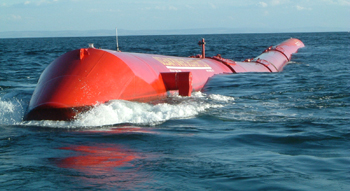
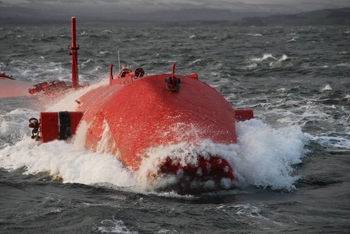
Sea snake-like wave machine Pelamis generates power by the wave motion
pumping fluid through hydraulic rams, which drive hydraulic motors
which then drive electrical generators. The resulting power is sent to
shore via a seabed cable. Several 140 m long Pelamis devices can
be linked together. Each machine is rated at 750kW, enough to
power 500 houses. Depending on the wave resource, machines will
on average produce 25-40% of the full rated output over the course
of a year.
Three Pelamis wave machines are being tested commercially at sea off the coast of Portugal. Another four are planned to be installed at the European Marine Energy Centre (EMEC) in the Orkneys. The UK Government
and other public sector organisations have invested around £15 million
in the creation of the centre and its two marine laboratories, one for
wave power, the other for testing tidal stream technologies.
The
Carbon Trust estimates that the coasts of Britain are one of the
richest sources of tidal stream energy in the world. Because this
technology is in its infancy we do not know yet what is the best type
of machine to extract this energy - horizontal axis turbines, vertical
axis turbines, oscillating hydrofoil machines and venturi-based devices
(a tube that increases the speed of the water-flow) have been
proposed. Once it is determined which is the best design, not
just in terms of energy produced, but also low-maintenance and minimum
environmental disturbance, then they can be rolled out (or rather sunk)
around the coast.
|
| Photo credit Southwest RDA |
|
Another
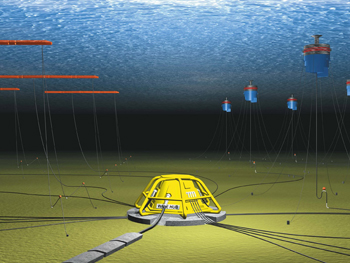
project is the Cornwall Wave Hub. It is a module for connecting
wave and tidal generation devices to the shore. Essentially it’s
like a marine version of a home extension socket – the devices are
plugged into it and the cable leads to the mains. This makes
testing wave devices much simpler, because they do not have to build an
electricity sub-station. Nor do they have to install the
monitoring capability each time a new device is linked. This will
speed up testing, as well as making the results uniform so which is the
best technology will be apparent. The devices attached to the Wave Hub
could generate enough electricity for 7,500 homes, directly saving
300,000 tonnes of carbon dioxide over 25 years. An independent economic
impact assessment commissioned by the South West Regional Development
Agency has shown that Wave Hub could create 1,800 jobs and £560 million
for the UK economy over the same period.
What are the environmental dangers?
Any
intervention into nature has effects. We have become more aware
of how all our technologies have environmental consequences, and these
new marine energy systems will be carefully sited to reduce the adverse
effects. It is unfortunate that the government currently favours
the large and intrusive Severn Barrage, which has given rise to
opposition because of the disruption it will have on the local
ecosystem. Other devices such as the wave hub and Pelamis will
have potentially much smaller environmental disturbance. The Cornwall
Wave Hub is intended as a test bed so that we can research the energy
generation potential of new inventions, and also their environmental
impact, in a real situation, rather than a laboratory.
Paul
Allen of CAT believes that the problems of deploying these systems are
not technological ones, but: “the political will and cross-party
consensus. It’s not an engineering challenge, but a social and
political one. Look how mobile phones changed from something the
size of a brick to something the size a matchbox. The technological
innovation is there. And there is enormous jobs potential, but
the government needs to set real incentives.”
Links:
Images of devices: http://www.bwea.com/marine/devices2.html
CAT: Centre for Alternative Technology http://www.cat.org.uk/
The Renewable Energy Centre http://www.therenewableenergycentre.co.uk/
Pelamis Wave Power: http://www.pelamiswave.com/
EMEC: http://www.emec.org.uk/
South West Regional Development Agency: http://www.southwestrda.org.uk/
|